


 0
0
For the groom-to-be, having to choose and find the outfit to wear on one of the most important days of his life can sometimes be confusing. Especially if it is not a suit that he usually wears. Which fabric to choose? A two-piece or three-piece suit? Which material, which color? Classic suit, morning coat or tuxedo?
We will try to help you make your choice by giving you the advice we feel is most relevant for your wedding suit. Much of it will also apply if you are one of the best men or just one of the guests.
There are various stages in the design of your outfit. The color and material of your suit will certainly be the first elements that will be noticed on this occasion. Just like the dress of your future wife or the bridesmaids, it is also the translation of a possible theme for your wedding. It is advisable to create an outfit in which you will be perfectly at ease.
The idea is not to dress up or to make a bet, but to express your personality through these clothes while staying within your budget, but without compromising on quality.
Book an appointment
In France, the wedding season generally coincides with the summer months. It is therefore important to choose fabrics that are breathable, so as not to suffer from the heat on the big day. To be sure, avoid any trace of polyester, as often found in ready-to-wear clothing.
A common fabric used in almost all suits today. Choose fabrics that are fairly lightweight, i.e. less than 300 grams/m2; anything heavier would be more suitable for winter. There are also different weaves, the most common being twill (diagonal lines in the fabric, known as twill for shirts), which has the particularity of not marking the folds too much and breathes fairly well.
Hopsack (weaving that produces a small-squared effect) is particularly recommended for the warmer seasons because it is woven more loosely and therefore breathes better, and wrinkles less.

Particularly suitable for the summer season, this blend gives the fabric a drape and a rather exceptional feel. The linen allows the fabric to breathe, while the wool gives it a drape and the silk makes it very soft and very pleasant to wear.
The Italians, who are fortunate enough to have a slightly longer and warmer summer than us, have understood this well, and the major houses such as Vitale Barberis or Loro Piana offer a wide range of colors in this weave.

The number one choice for us, this particular weave, which is gradually returning to the forefront and rightly so, offers a perfect drape, while being extremely breathable. Indeed, the wool threads are twisted back on themselves a large number of times and then woven in an airy manner. The result is a very dry fabric that does not crease at all and that breathes, while providing exceptional support and drape.
On the other hand, you have to accept that it is a little rough and less silky than a classic wool.

The summer fabric par excellence, it is particularly suited to a very casual and less formal style than the aforementioned fabrics. Very pleasant to wear, you have to accept the fact that it wrinkles a lot, but that is also what gives it so much charm, that crumpled linen look...
Only choose this if you want a more casual style on the day of your ceremony.

The same applies as for linen: this fabric is very casual and, like its predecessor, it also creases quite quickly. Cotton fabrics for making a suit are denser and therefore breathe a little less well.
Its advantage is that it is available in a very wide range of colors, allowing you to be as bold as you like.

A benchmark for good reason, it is the most classic choice and the one that will make you look elegant in all circumstances. A beautiful navy suit, well cut, will always produce the desired effect. If you want a more assertive style, you can also opt for petrol blue, blue-gray or sky blue, which have been very trendy in recent seasons.
For some, this choice seems austere, but we can assure you that a beautiful suit in a medium gray will make a great impression. A very traditional option, to be paired with a white or light sky blue shirt, a burgundy, green or navy tie, and black shoes. This outfit will immediately bring elegance and formality to your ceremony.
It is true that choosing a suit that is not navy or gray is not necessarily easy. However, there are a few alternatives that can set you apart, of course if you are comfortable in them and feel confident. It is absolutely not a question of following fashion or trends, whether for everyday wear or even more so on your wedding day (the photos will remain). Green, burgundy or beige are more original colors but can be quite suitable for a ceremony.
Book an appointment

After choosing the materials and colors, it is time to choose the style options. They will personalize and set the tone for your outfit. It is therefore important to think carefully about the style you want to give your costume and whether it reflects who you are.
The three-piece suit, consisting of a jacket, trousers and of course a waistcoat, is a particularly interesting choice for a wedding. Having fallen out of fashion in everyday life in recent years, it is very formal and therefore tends to identify you as the groom. Which can be appreciated on your wedding day. For this type of suit, the choice of waistcoat will be decisive. If you prefer a more English style, choose a straight waistcoat with a fairly high fastening, or a double-breasted waistcoat with a shawl lape (which we particularly like at Swann's). If, on the other hand, you prefer a more Latin style, opt for a more open straight waistcoat.
It is also possible, to reinforce the style of your suit, to mismatch the waistcoat. For example, a navy suit and a cream or gray houndstooth waistcoat. If this is the case, it should be combined with a neutral shirt, white or very light sky blue, and you should choose an accessory, a tie or a bow tie that contrasts but in classic colors; sand, pink, burgundy for example.
The two-piece suit is also a very classic choice. In navy blue or medium gray as we have seen, to be combined with a white or sky blue shirt, and a more fancy tie (cashmere or paisley patterns) if you want to step it up a notch.
The most classic today is the two-button jacket. With fewer buttons than a three-button jacket, it is more elegant and offers a nice lapel.
If you are wearing a classic outfit, you can also choose a fake three-button jacket. This means that there will be a button higher up, but it will not be meant to be fastened. However, the rolled on the lapels will be slightly less plunging.

If you want to keep things formal, the notch lapel is the most common on suits today.
For a more distinctive, more Italian style, Peak lapel is also a nice option.
In any case, favor good proportions. A lapel for example, should measure about half the distance between the edge of the jacket and the sleeve.

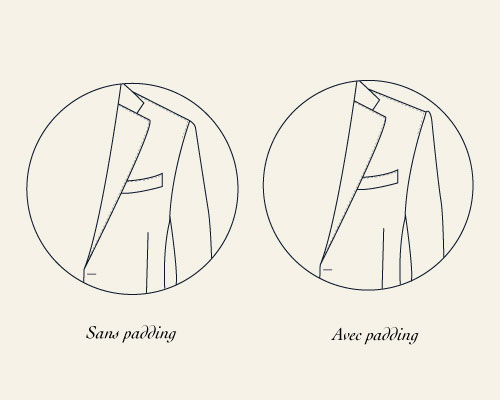
The shape of the shoulder can be very important in the style of a suit. For a very formal and rather British style, the shoulder with a lot of padding (piece of felt placed on the shoulder to give it its thickness) will be the best choice. If you want something classic but more nonchalant, you should go for a softer shoulder with less padding, the advantage of which will be that the shoulder of the jacket will follow the natural shape of your shoulder.
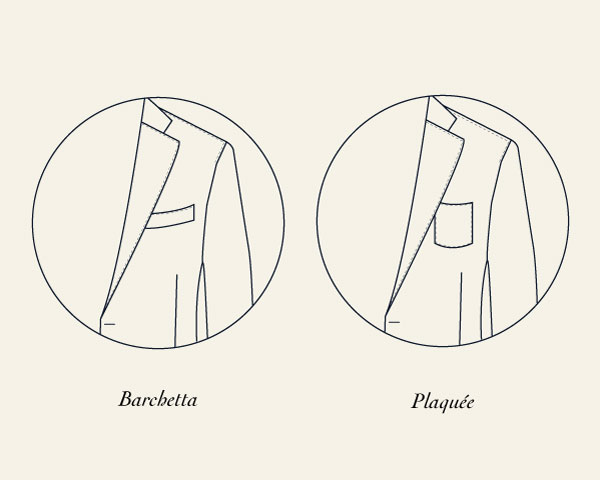
For a classic, formal suit, the Barchetta breast pocket (it is curved and therefore resembles the shape of a boat, hence its name in Italian).
If you choose a more casual outfit, the patch pocket can be a nice option, but only if the side pockets are too.
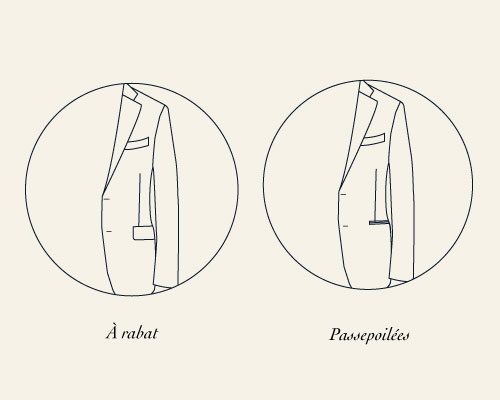
The most classic pockets are flap pockets. Found on almost all formal suits, they are a risk-free choice. You can also decide to have them slanted.
If you want to give it a more formal look, you could also choose jet pockets. They will give your jacket a more refined look.
Certainly the most nonchalant and casual choice. They will bring a more relaxed side to your outfit.
If you want to keep up a certain tradition, choose the hornless kind, but if the environment is your main concern, go for galalith, also known as milkstone. This material is biodegradable.

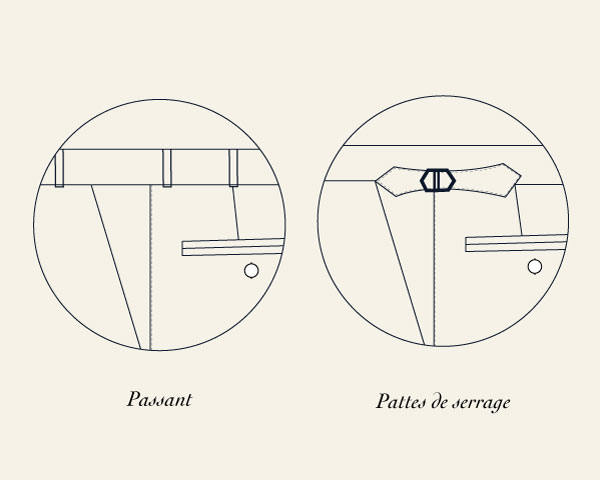
With loops for wearing it with a belt or with side adjusters, which we find much more comfortable and elegant. This is because a belt tends to cut the figure in half. It can also sometimes be uncomfortable, particularly at the table.
If you choose a 3-room apartment, opt for the side adjusters, because as the waistcoat must go down to the waistband of the trousers, there will be no excess thickness. This also saves you from having to look for a belt in the same leather as your shoes at all costs.
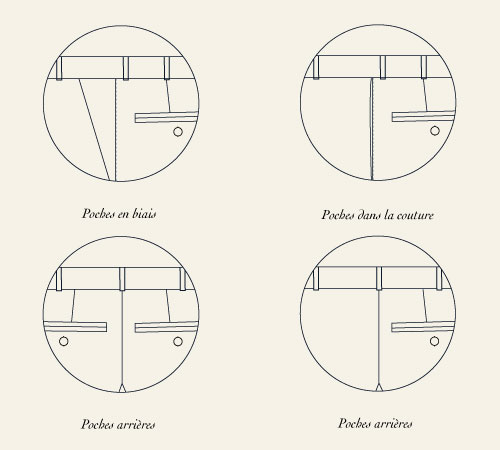
Classic pockets are slanted pockets, also known as Italian pockets. These are the most common type of pockets on trousers today. If you want a more formal look, you can choose inseam pockets, which are positioned along the seam of the leg, making them the most discreet.
Two jet pockets or just one on the right? It's a question that may arise. Nowadays, the classic is to have two, whereas in the past it was more common to have just one.
The most classic sock today, with a break on the shoe or just above it, it's up to you. On the other hand, avoid the accordion effect on the shoe, as it will give the impression that you haven't spent much time taking care of your outfit.
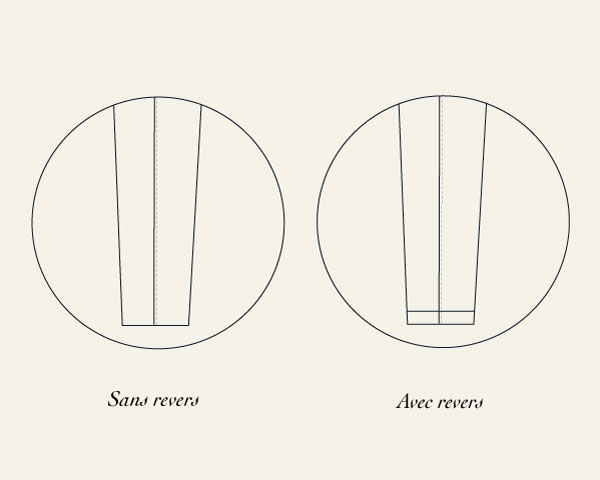
It is an increasingly popular choice, as it gives a cleaner look to the leg because of the turn-up hem. 4 cm is the most classic. 5 cm if you want a more Italian style.
In addition to ensuring that the garment is tailored to your body shape, neither too loose nor too slim, and that you feel comfortable in it, this service also allows you to choose all the details that we have just seen. Your garment will not be part of any men's collection and will be made just for you in our workshop.
Keep in mind that it is a special purchase for that day and your evening, but you can also plan to treat yourself to a suit that you can wear in a more business-like setting, for example.
Book an appointment
Navy is the most versatile choice. Elegant and timeless, it works just as well for a classic city wedding as for a formal religious ceremony. In worsted wool, it is particularly well suited to formal occasions; a more textured cloth gives it a more relaxed character.
Grey is a classic alternative to navy. Charcoal grey suits formal weddings, especially in autumn and winter. Mid-grey and light grey feel brighter and work particularly well for spring and summer ceremonies. Grey also pairs easily with a white shirt and a restrained tie.
Beige is particularly well suited to spring and summer weddings. It feels at home in the countryside, at an estate or at an outdoor ceremony. Lightweight wool retains a degree of formality, while linen or a wool-and-linen blend creates a more relaxed look.
Ecru brings a light, distinctive elegance that works especially well for summer weddings by the sea or in a Mediterranean setting. It requires a little more care when choosing the cloth and accessories. For a very formal ceremony, opt for a refined, non-shiny fabric.
The groomsmen’s suits do not need to match the groom’s exactly. The aim is to create a sense of harmony while allowing the groom to stand apart. You might choose the same colour in different shades, keep a similar cut while varying the cloth, or simply coordinate accessories such as ties, pocket squares and buttonholes. The groom can distinguish himself with a different shade, a contrasting waistcoat, a more distinctive cloth or particular details of construction. For a classic wedding, navy suits for the groomsmen paired with a slightly different shade of blue for the groom can work beautifully. For a summer ceremony, shades of beige, sand and light grey create a brighter, more relaxed palette. Having the groom’s and groomsmen’s suits made by the same tailor makes it easier to achieve this balance. Each suit can be cut to suit the wearer’s build while maintaining a coherent overall look and respecting the budget. At Swann Paris, having several made-to-measure suits made together allows you to create a consistent look for the wedding party without dressing everyone identically. The result feels more harmonious and personal, while allowing the groom to retain his own place in the group.
Choose a breathable cloth suited to warmer weather. Fresco is our first choice: it holds its shape well and resists creasing. Lightweight pure wool, ideally under 300 g/m², wool, linen and silk blends, or linen for a more relaxed look are also good options. An open weave can help air circulate and make the suit more comfortable in the heat.
Both are excellent options. Any of our two-piece suits can be complemented by a waistcoat, made in the same cloth or in a contrasting fabric, from €250. A three-piece suit with a matching waistcoat creates a more formal look. A contrasting waistcoat brings more individuality and a slightly more relaxed feel, while remaining elegant. The two-piece suit is the classic, dependable choice. One advantage of a waistcoat is that it can be removed later in the day for a less formal look.
Our made-to-measure wedding suits start at €900 for a two-piece suit and €1,160 for a fully canvassed two-piece. A three-piece suit can cost up to €2,130. The final price depends primarily on the cloth and the construction, including whether the jacket is half-canvassed or fully canvassed, and the extent of the traditional handwork involved.
A suit is suitable for most weddings, whether the ceremony takes place during the day or in the evening. A morning coat is the traditional, highly codified choice for formal daytime occasions. A dinner suit is intended for evening events with a black-tie dress code. Some grooms choose to wear a suit or morning coat during the day, then change into a dinner suit for the evening reception.
Ideally, allow two months before the wedding. Delivery takes four to five weeks, leaving time for a fitting and any necessary alterations. There will be enough to think about in the days before the wedding, so ordering early means one less thing to worry about.